Matrix Multiplication Row Operations
In matrix multiplication since each of the input matrices can be accessed in either a row-major order or column-major order there are four possible ways to perform matrix multiplication inner product row times column outer product column times row row-wise product row times row and column-. For matrices there are three basic row operations.

Pin On Easycodebook Com Programs With Source Code
Elementary row operations as matrix multiplication We saw in section 24 that a matrix can be transformed to row echelon form by elementary row operations.

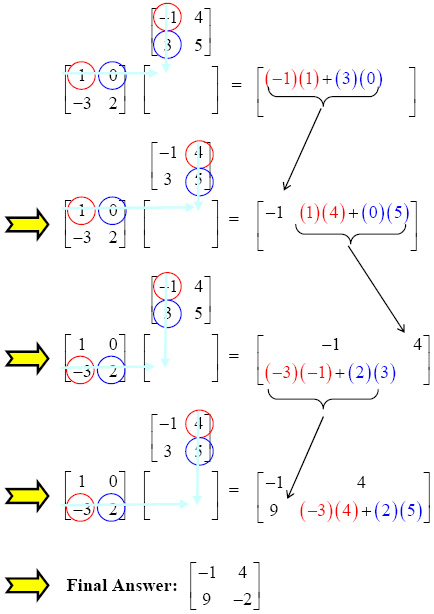
Matrix multiplication row operations. For example the system on the left corresponds to the augmented matrix on the right. Multiply row 1 elements of Matrix A by column 1 elements of Matrix B and add the result. Introduction to R There are multiple matrix operations that you can perform in R.
To multiply matrices they need to be in a certain order. Kind of like subtraction where 2-3 -1 but 3-21 it changes the answer. Adding a constant multiple of a row to another row.
X n F J J H a 1 x 1 a 2 x 2 a n x n. Addition substraction and multiplication calculating the power the rank the determinant the diagonal the eigenvalues and eigenvectors the transpose and decomposing the matrix by different methods. Systems of equations and matrix row operations Recall that in an augmented matrix each row represents one equation in the system and each column represents a variable or the constant terms.
There is only one element in the new matrix. A a 1 a 2 a n B E I I G x 1 x 2. There are three types of row operations.
Matrices its Operations using Python. Operations is mathematician-ese for procedures. Again we work with the system given by Ax b.
Try some of the following and see what works. We have some constraints before we could add or. Addition subtraction and multiplication are the basic operations on the matrix.
The row-column rule for matrix multiplication. For some sequence of matrices R1R2Rk. So if you did matrix 1 times matrix 2 then b must equal c in dimensions.
Consider the two row operations R2 R3 R 2 R 3 and R1 R2 R1 R 1 R 2 R 1 applied as follows to show A B. The four basic operations on numbers are addition subtraction multiplication and division. Row switching that is.
If you had matrix 1 with dimensions axb and matrix 2 with cxd then it depends on what order you multiply them. A matrix is a rectangular array or a table of numbers arranged in row and columns. That is there are three procedures that you can do with the rows of a matrix.
Row addition that is adding a row to another. In general the matrix that represents the linear transformation thatmultiplies row i by some nonzero constant alpha can be obtained by multiplying row i of the identity matrix by alpha. The first operation is row-switching.
The count of these row and columns of a matrix is termed as order of matrix. However to be able to execute these operations by machines we need to represent these. The row 1 column 1 element.
Row multiplication that is multiplying all entries of a row by a non-zero constant. The answer is going to be a matrix of zeroes and ones since you just want to move the elements around not scale them. Express these row operations as matrix multiplication by expressing B B as the product of two matrices and A.
Doing a ktimes l times ltimes m matrix multiplication in the straightforward way every entry of the result is a scalar product of of two l-vectors which requires l multiplications and l-1 additions. This means c A a B c d A b B d a C a D c and b b C D d. 4 1 5 3 2 14 5 2 31 4 10 3 3 1 A B A B 3.
Recall from this definition in Section 23 that the product of a row vector and a column vector is the scalar. R 1 R 2 R k.

Pin On Numpy

Pin On Linear Algebra

Pin On Math Aids Com

Understanding Affine Transformations With Matrix Mathematics Matrices Math Mathematics Math

Pin On Math Aids Com

Numpy Cheat Sheet Matrix Multiplication Math Operations Multiplying Matrices

Pin On Matrix

Matrices Foldable Matrices Math Math Interactive Notebook Algebra
Pin On Matematicas

Pin On 10 Math Problems

Pin On Students

Experiment Self Teaching Math Formulas Learning Math Teaching Algebra

Pin On Programming
Pin On Ms2 Algebra Ideas

Pin On Matematicas

Pin On Graph Theory

Pin On Math Aids Com

Pin On High School Math

Pin On Math